


"AI and the Countdown to Mortality: The Death Clock's Impact on Health, Wealth, and Ethics"
Unlock the power of the AI Death Clock! Plan wisely, live healthier, and cherish every moment. Find inspiration, laugh, and take control of your future today!
MENTAL WELLNESS
Sharada Sharma
12/5/20242 min read
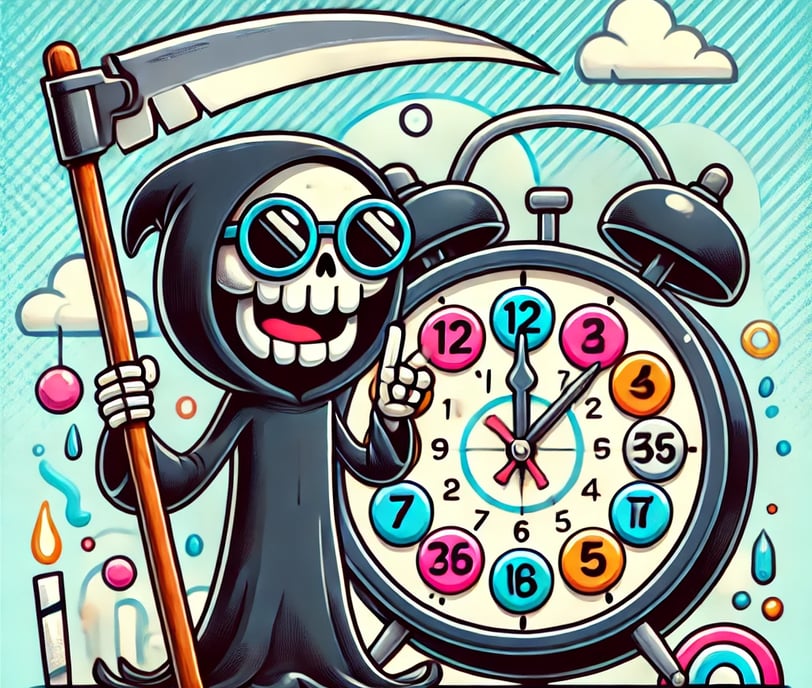
I have been hearing about news related to a "Death Clock" app on the internet and wondered why it is making headlines!
Being a psychologist, I can guess how humans avoid talking about death most of the time, although it is the ultimate reality everyone has to face. I did check out the page of "Death Clock" and at least to me, it did not appear all that intimidating.
The app was created by Brent Franson and it leverages data from over 1,200 life expectancy studies involving around 53 million participants to make its predictions. This approach allows for far more personalized and likely more accurate results compared to the generalized ranges found in traditional health tables. Users input key details like their birth date, BMI, smoking habits, and location, enabling the AI to calculate their life expectancy and display a countdown to their predicted "death date."
The app, featuring a morbid "Grim Reaper" interface, has gained popularity, ranking high in health and fitness app categories. Users are drawn to its potential for promoting healthier living.
As we know, humans are living longer than in the past. So, an app like this can go beyond personal use. Its technology holds economic significance, impacting financial planning, life insurance, and retirement strategies. The AI's granular insights could enhance economic models traditionally reliant on broad averages.
Recent studies, like one from the National Bureau of Economic Research, highlight the limitations of chronological age in policies like retirement. Others have assessed the economic "value of statistical life," revealing disparities based on health and income.
The app also highlights broader societal issues, such as the longevity gap driven by wealth inequality. Studies show a stark contrast in life expectancy between rich and poor Americans.
While the Death Clock provides personalized suggestions for improving health, critics raise ethical and psychological concerns. The app's $40 subscription fee may exclude lower-income users, perpetuating inequities.
Additionally, the psychological impact of a "death countdown" and the potential misuse of sensitive data are contentious.
Ultimately, the app blends opportunity and risk—offering motivation for a healthier life while prompting ethical reflection on mortality’s complex and personal nature.
What are your thoughts about the Death Clock?
Sign Up With Email
© 2024. whispersofmind.in. All rights reserved.
Be the first one to explore new insights on psychology and mental health.